Posted on

Streaks, Missing Colours and Faded Prints: How to Unclog a Print Head Without Wrecking It

Most “my printer is broken” calls we get on 0800 INKINK are a dried print head, not a dead printer. In about eight cases out of ten you can fix it yourself — twenty minutes for a light clog, overnight for a stubborn one. But the right method depends on where your print head lives, and getting that wrong is how people turn a $20 problem into a $300 one.

First, find out what kind of printer you have

This is the single most important thing on this page, and almost no guide mentions it.

Print head location Brands / models What this means for you
Fixed inside the printer All Epson, all Brother, HP OfficeJet Pro, HP Smart Tank Cleaning has to be done in place, through the ink inlets
Removable Canon MAXIFY and PIXMA G (MegaTank), some HP The head lifts out and can be soaked properly — the most effective method there is
Built into the cartridge HP 61/63/65/67, HP 302/304, Canon PG- and CL- series Replacing the cartridge replaces the head. A soak can still revive one — worth trying before you bin it

How to tell in ten seconds: look at your old cartridge. A copper-coloured strip or a row of tiny gold contacts on the bottom face means the print head is in the cartridge. Just a plastic box with a chip on the side means the head is in the printer.

Step 1: Print a nozzle check, not a test page

A test page tells you the printer talks to the computer. A nozzle check tells you which nozzles are blocked. People confuse these constantly.

  • Brother — Ink / Maintenance → Improve Print Quality → Check Print Quality
  • Epson — Printer Settings → Maintenance → Print Head Nozzle Check
  • Canon — Setup → Maintenance → Nozzle Check
  • HP — Tools → Print Quality Report

Photograph the result. You will want to compare after each attempt, and “it looks a bit better” is not a measurement.

  • Whole colour missing → that channel is fully blocked, or the cartridge is empty or not recognised
  • Broken lines with gaps → partial clog. This is the one that cleans up well
  • Everything faint but complete → usually not a clog. Check ink levels and paper settings first
  • Colours in the wrong position → not a clog at all. You need head alignment, a different menu item

Step 2: Run the built-in cleaning — but only twice

Run it, print another nozzle check, compare with your photo. If it improved but is not perfect, run it once more. Then stop.

This is where most damage happens. Each cycle pumps ink through the head into an internal waste pad. On Epson models a counter tracks this, and when it fills the printer refuses to print until it is serviced. Ten cycles in a row can burn more ink than a full set of cartridges.

Step 3: Let it rest overnight

If two cycles did not clear it, the blockage is dried pigment. Force will not move it — time will.

  1. Run one cleaning cycle
  2. Turn the printer off using its own power button, not the wall switch
  3. Leave it 8–12 hours
  4. Turn it on and run a nozzle check

Why the printer’s own button matters: shutting down properly parks the head on its rubber capping station, which seals it against air. Killing the power at the wall leaves the head exposed to dry out further overnight — which is how an occasional clog becomes a permanent one.

Step 4: Clean the head directly

Still blocked? This is the last thing to try at home, and done correctly it rescues a lot of printers that would otherwise be thrown out.
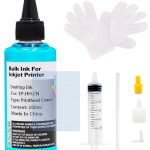
Buy it here
Printer Head Nozzle Cleaning Kit
$19.99incl GSTIn stock in AucklandAdd to cart

From the kitchen: a roll of paper towel. That is all “blotting paper” means here — a few folded sheets of ordinary kitchen towel is what we use ourselves.

Three rules that matter more than the technique:

  1. Power off, and keep it off for the whole process
  2. Fold paper towel under the head before you inject anything. Cleaning fluid on the circuit board is the one mistake you cannot undo
  3. Gently. 1–2 ml per go, pushed slowly. The nozzles are finer than a human hair — you are dissolving a blockage, not blasting it

If your head is fixed (Brother, Epson)

  1. Power off and remove the cartridges
  2. Slide a folded pad of paper towel under the head, in the middle of its track
  3. Fit the silicone tube to the syringe and draw up cleaning fluid
  4. Seat the tube over the ink inlet column on top of the head, fully covering it
  5. Inject 1–2 ml, slowly
  6. Remove the towel, mop up residue, refit the cartridges
  7. Run one cleaning cycle, then a nozzle check

If your head is removable (Canon MAXIFY / PIXMA G)

  1. Remove the cartridges, then lift out the print head
  2. Stand it in a shallow container of cleaning fluid — the fluid must stay below the chip contacts
  3. 15–30 minutes for a light clog; 3–12 hours if badly blocked
  4. Dry it completely, especially the contacts
  5. Refit, run one cleaning cycle and a nozzle check

Canon owners: pick the right nozzle

Canon heads use two inlet sizes. The white nozzle is for the PGBK pigment black channel; the yellow nozzle is for the others. Forcing the wrong one on is how inlets get damaged.

What not to do

  • No isopropyl alcohol, no methylated spirits. They strip lubricant from the head and attack the adhesive holding the nozzle plate on
  • No tap water. Auckland tap water leaves mineral deposits in passages measured in microns
  • Nothing sharp. Not a pin, not a needle, not a paperclip
  • No hard pushing. If 2 ml will not go through gently, soak it longer

Why it clogged in the first place

It sat unused. A printer used once a month will clog; the same printer used twice a week usually will not. If you print rarely, print one colour page a week — it costs a few cents and saves the head.

It is somewhere warm and dry. A printer in a sunny window or above a heat pump outlet dries faster. Move it.

It was switched off at the wall. As above — the head never gets capped.

Still stuck?

Call 0800 INKINK and talk to someone in New Zealand who deals with this every day. Tell us the printer model and what the nozzle check looks like. We would rather tell you not to buy something than sell you a cartridge that will not fix your problem.
Posted on

Brother Ink Cartridges: How to Stop Overpaying Without Risking Your Printer

Brother is the most common printer brand we supply in New Zealand — by a wide margin. It is also the brand whose owners have the fewest official ways to cut their running costs. This page explains what your options actually are, which ones are safe, and how to work out which cartridge your printer takes.

Why Brother owners feel this the most

Epson has EcoTank. Canon has MegaTank. Both are refillable bottle systems, and both are marketed hard on running cost.

Brother’s answer in New Zealand is Inkvestment — larger cartridges and a long in-box supply — rather than a refillable bottle system. It genuinely does last longer than a standard cartridge. But it is still a cartridge, and when it runs out you are still buying a cartridge.

So if you own a Brother inkjet and you think the ink is expensive, there is no official path to make it cheaper. That is the whole reason this page exists.

Your four options, honestly compared

Option What it is Worth knowing
Genuine Brother Brother-branded cartridge Highest cost per page. No compatibility questions, ever.
Genuine high-yield (XL) Same cartridge, more ink Almost always better value per page than the standard genuine. If you are staying genuine, buy XL.
Compatible New third-party cartridge, new chip What we sell. Lower cost per page. Quality varies a lot between suppliers — see below.
Refilling your own Injecting ink into a used cartridge Cheapest per millilitre, messiest, and the chip often still reports empty. We do not recommend it for Brother.

We are not going to publish a “save 70%” figure, because genuine prices move and a comparison is only meaningful if it is against a real price on the day you buy. Our prices are on this page. Check them against whatever your usual retailer is charging today and judge for yourself.

Is a compatible cartridge safe in a Brother?

Of the four major brands, Brother has historically been the most tolerant of third-party consumables.

In March 2025, when users publicly alleged that firmware updates were degrading print quality with non-Brother supplies, Brother’s response was that its firmware updates “do not block the use of third-party ink and toner cartridges in our machines” and that its printers do not intentionally degrade print quality based on which cartridge is fitted.

Those claims remain disputed rather than settled, and we mention it so you can make your own call. The sensible precaution is the same on any brand: if third-party cartridges are working for you, do not let the printer update its firmware unasked.

On the warranty question: under the Consumer Guarantees Act 1993, using a third-party cartridge does not automatically void your printer warranty. For a manufacturer to decline a repair on those grounds, the cartridge would have to have actually caused the fault. This is general information about how the law works, not legal advice on your situation.

Which cartridge does my Brother take?

This is where most people go wrong, and it is the single most common reason a cartridge gets returned.

The model number is on the front of the printer, and again on a label on the back or underneath. It looks like MFC-J491DW or DCP-L2540DW or HL-L2350DW. It is not the long serial number — that is a different thing and it will not help you.

Once you have it, look it up rather than guessing. Brother model numbers are close enough to each other that a single wrong digit gets you a cartridge that physically fits and then reports an error.

Not sure? Type your printer model into our finder and it will tell you every cartridge that fits it, or call 0800 INKINK and read the model off the label to us.

Our Brother ink

These are the Brother cartridges New Zealanders order from us most. Every one is a new compatible cartridge — factory sealed, not refilled and not remanufactured.

Buy it here
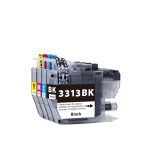
Brother LC3313 Ink Cartridge - Professional Recommended
Fits 1 printer model, including MFCJ491DW.
Price range: $17.20 through $68.81incl GSTIn stock in AucklandAdd to cart
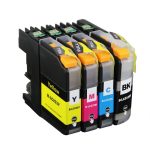
Brother LC233 Ink Cartridge - Professional Recommended
Fits 6 printer models, including DCPJ4120DW, MFCJ4620DW, MFCJ480DW and more.
Price range: $9.98 through $34.50incl GSTIn stock in AucklandAdd to cart
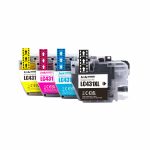
Brother LC431XL Ink Cartridge - Professional Recommended
Fits 2 printer models, including DCP-J1050DW, MFC-J1010DW.
Price range: $17.49 through $27.50incl GSTIn stock in AucklandAdd to cart

If your Brother is printing badly, do not buy ink yet

Faded print, missing colours or streaky lines on a Brother is more often a dried print head than an empty cartridge. Brother heads are fixed inside the printer, so they need cleaning in place.

Run the built-in cleaning cycle twice — no more — then leave the printer switched off overnight using its own power button. That alone fixes a large share of the calls we get. If it is still blocked after that, a proper cleaning kit is the next step, and it costs a lot less than a printer.

Buy it here
Printer Head Nozzle Cleaning Kit
$19.99incl GSTIn stock in AucklandAdd to cart

The full method, including what not to do, is in our print head guide.

Still not sure?

Call 0800 INKINK and tell us the printer model and what the page looks like. We would rather tell you not to buy something than sell you a cartridge that will not fix your problem.